German Military, Police to Team Up Amid Fears of ISIS Attack
byAndy Eckardt
MAINZ, Germany — Germany is preparing to train
troops to be deployed within its borders for the first time since World
War II amid fears of terrorist attacks.
The country's armed forces will hold joint drills with police early next year, officials confirmed.
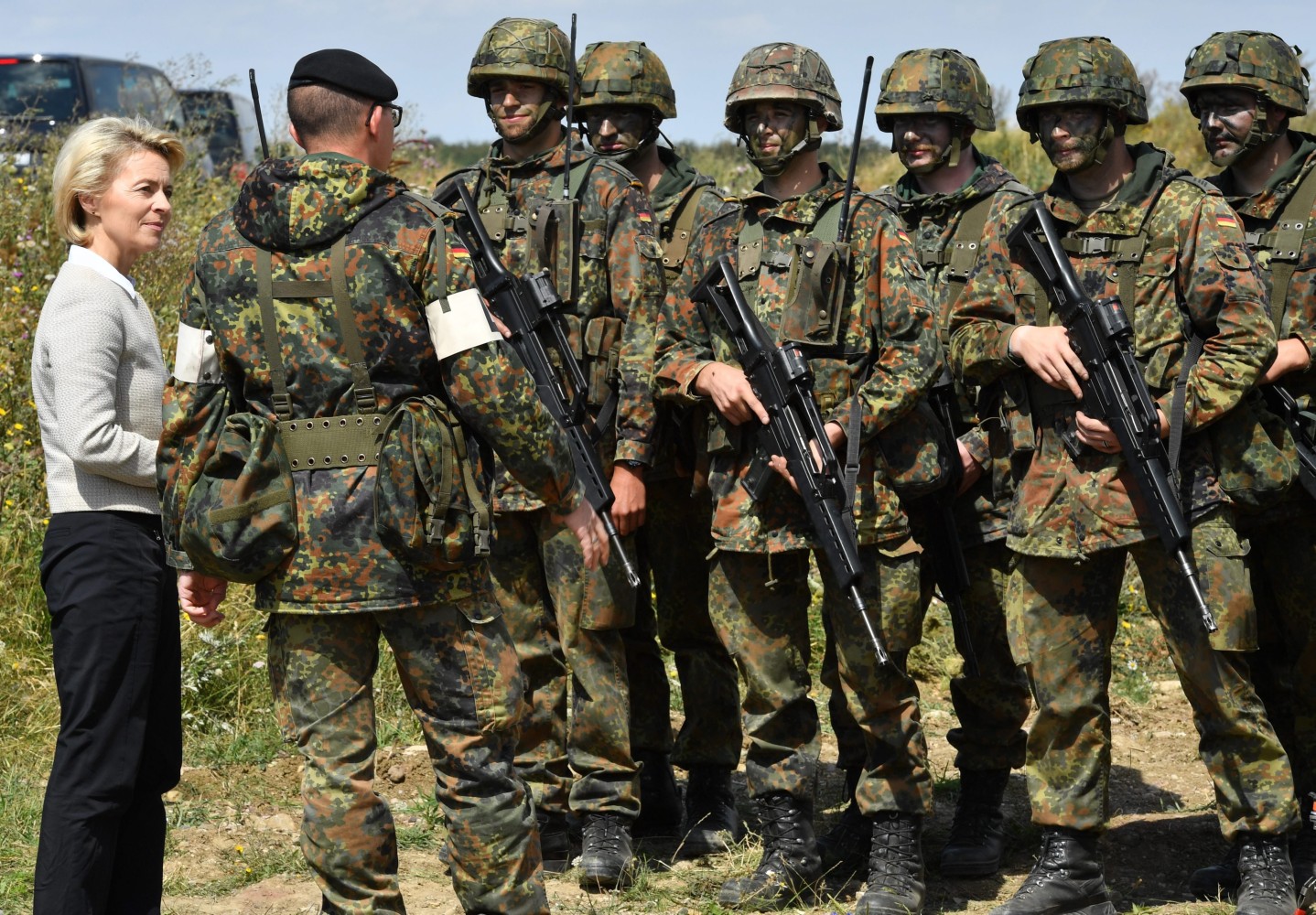
Defense Minister Ursula von der Leyen speaks with soldiers at a base in Ohrdruf, Germany, on Aug. 9. MARTIN SCHUTT / EPA
Authorities stress that counterterrorism measures will primarily remain the responsibility of police.
However, the potential for large-scale attacks
have made the use of German military assets "conceivable, even
probable," according to Lt. Gen. Martin Schelleis, the Bundeswehr's
chief of joint support services.
Plans to involve soldiers in counterterrorism
operations — and the suggestion troops could also be used to beef up
security in public places — have proved controversial in a country only seven decades removed from totalitarian rule that's still grappling with guilt from the Nazi era.
A 2012 constitutional court ruling paved the way
for the deployment of the Bundeswehr on German streets in the aftermath
of an attack. Special Report: How Europe Is Confronting Terrorism
Until then, Germany's constitution had allowed
for domestic military missions only under special circumstances — such
as natural disaster relief.
The restrictive legal framework was instituted as a result of Nazi leader Adolf Hitler's abuse of state powers.
Schelleis suggested that a terrorist attack
could qualify as "such a grave disaster" to allow the armed forces to
support the police.
"What matters in a large-scale terrorist
situation is that quick and effective action is taken," he told NBC
News. "This calls for the procedures to be coordinated and practiced."
Schelleis added the military assistance on offer
could include low-altitude air space surveillance, checkpoints,
explosive ordnance disposal and even advice on nuclear, biological and
chemical threat situations.
"We could also provide mobile laboratory
capabilities," Schelleis said. "Our troops are excellently trained. The
same applies to medical personnel, who are well versed in treating
gunshot and burn injuries."
Lt. Gen. Martin Schelleis (right) is the Bundeswehr's chief of joint support services. R. Alpers / Bundeswehr
The joint exercises are due to take place in February in four German states.
Debate over deploying the Bundeswehr inside
Germany has raged for years — with some high-ranking officials still not
convinced that the threat from ISIS and other extremist groups warrant
such a change in approach.
Following a shooting rampage in Munich in late July,
German Foreign Minister Frank-Walter Steinmeier told the Passauer
Presse newspaper that the "incident showed the speed and the great
degree of professionalism of the police forces."
He added: "There were no gaps that could or needed to have been filled by the Bundeswehr."




No comments:
Post a Comment